 I’ve covered the basics of worldview, it is a complex topic but I was as brief as possible. This post is a bit more about why it is relevant to game design. The simplest way to put it is that your worldview helps to filter information that comes to you every day. Your worldview is going to be the main tool you use to find the kinds of experiences that are going to fulfill your needs. In video games, your worldview is going to help you pick the game you want to play and make sense of that experience. For one group of gamers I came across in my research, the answer to which game they would play was simply, none.
The Research
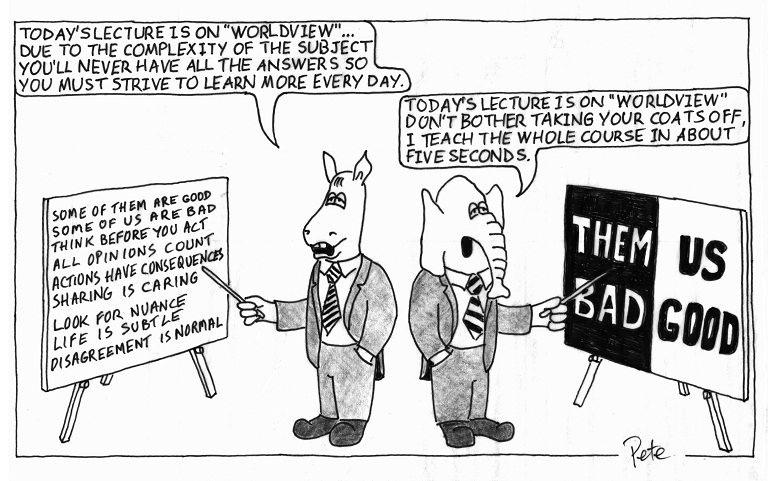
One of the more interesting things to come out of my dissertation was a conclusion that there are some people looking for challenges to their beliefs. They are motivated to find those kinds of experiences that help them to grow. This might seem purely intellectual but there are many different kinds of intelligence. Social, emotional and intellectual intelligence are all valid targets for the kinds of dissonance that these people are seeking. They are looking for these kinds of experiences everywhere, in books, movies, television, whatever media they can find.
I haven’t included games in that list on purpose. Although game design is all about understanding the motivation behind your player and designing game challenges that can fulfill those motivations, these kinds of players weren’t finding those kinds of challenges in video games. In fact, most of them talked about leaving games behind as they just weren’t getting what they needed from gameplay anymore. They would still play occasionally with their friends as more of a social activity but games didn’t really interest them beyond that.
There are a lot of reasons for this switch. Much of it seems to be based on their lack of ability to find the right kind of game. Some of it is based on societal beliefs that games are a waste of time. With that belief in mind they simply aren’t looking very hard for a different kind of game. Sometimes they only saw games as the escape mechanism they had used through adolescence to survive. They didn’t even think that games were used for anything more than a temporary retreat from life. For many games were headed into the same kind of cultural ghetto as comic books, a shallow, one-dimensional experience that they would quickly dismiss. They have limited free time and they don’t want to waste it. They are going to use it to pursue the activities they see as most meaningful.
The Game
So the real question is if a different kind of game existed would they even play it? If there was something that could provide an experience would might lead to personal growth would it interest them? I’ve seen a lot of the advocational and serious games out there that are supposed to provide “meaningful” experiences for people. They get a lot of press but not a lot of players. They must be missing something in their design, or they were designing for the wrong people. Something didn’t quite click and to most people it was suspiciously like another offering of chocolate covered broccoli.
There are a couple of things standing in the way of commercial companies every publishing these kinds of games. One is that the worldview of the game is a reflection of the worldview of the game designer. It would take a designer with a pretty extensive understanding of personal epistemology to design a game that would address the needs of different worldviews. As far as I know, there aren’t a lot of classes or books on the subject in the game design world. Perhaps they will eventually come. The second reason is that this is new and risky territory. Game companies exist to make money and taking risks on new ideas isn’t popular with the people who run those companies. Right now there are a lot of independent companies trying to be innovative but they aren’t getting rich and most people don’t even know their games exist.
So here comes the motication for some new experiments in game design. There are already a lot of people out there experiementing with game design. I’ll be talking to them about what motivates them and what they are discovering. The academic world often talks about this kind of creativity but they rarely seem to have the resources to actually build it. That means I’ll probably be talking to game designers and independent game companies. Eventually it will be time to take these ideas and create a design document for a new game. The next step will be building that game and getting it out there. It will need to be an agile development, getting as many interations out there as possible. I suspect a lot of mistakes will be made along the way and it will be important to learn from those mistakes quickly.
The Itch
We are all born with the burning itch of curiosity. It drove us ask questions and seek out new experiences. Sometimes we settle down and stop asking the questions because we think we have all the answers, or someone has told you they have all the answers. For the people that are still going, who are still driven to keep that curiousity alive, video games should be one of the most dynamic, vibrant parts of their lives. Games haven’t quite achieved that yet but perhaps it is time to think about who they will.

 Outgrown Games